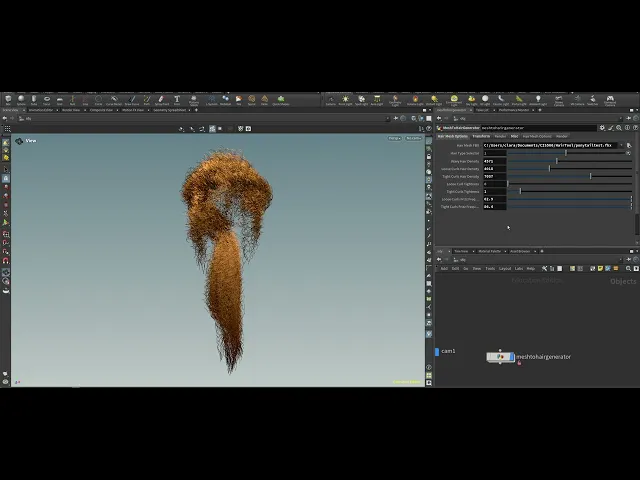
Hair Meshify HDA

Year
'24
Client
Service
This project explores the creation of a procedural hair generation pipeline inspired by Disney's in-house tool, Tonic. Motivated by the need for inclusive and diverse hair representations in animation and games, we developed a system that procedurally creates guide curves and hair strands on a 3D mesh, supporting varied curl patterns and styles.
© Hair Meshify HDA


Motivation
Hair diversity, especially across curl textures from 1A to 4C, is often overlooked in real-time graphics pipelines. Disney’s Encanto and Wish set new standards by showcasing complex hairstyles using Tonic and Houdini. Our project set out to build a functional prototype inspired by these advancements, offering procedural control, physical realism, and stylization potential.
Solution
We began by allowing users to input a simplified mesh volume representing a hair clump or region. This mesh is automatically processed to extract centerlines and generate guide curves using Houdini SOP tools.
Each generated curve represents the root-to-tip flow of a potential strand or clump. These curves are deformable via control vertices and align with the mesh topology to avoid bald spots, overlaps, or intersections.
We then implemented a procedural Vellum simulation that creates various curl patterns and braid structures. Users can:
Adjust frequency and amplitude of sine waves to simulate coils and waves
Apply strand-level variation using ramp controls
Use a custom knot pattern generator for braids
Strands are animated and stabilized using Houdini's Vellum solver, which also handles intra-strand collision detection.
Hair strands are swept into geometry for rendering and real-time previews. The tool supports multiple levels of hierarchy (root > clump > strand) and exports geometry ready for import into grooming environments or real-time engines.
Papaya USD Asset Browser